
I get asked about pores more than almost any other skin concern. Specifically: how do you make them smaller? And the honest first answer is that you cannot. Pores are openings in your skin. They do not open and close, and they cannot be physically reduced in size. What you can do, with the right ingredient used consistently, is make them look significantly smaller. After testing a lot of approaches over the past few years, niacinamide is the most practical and reliable way I have found to do that.
This guide walks through exactly how niacinamide works on pore appearance, the five-step routine I follow, what to pair it with, what to skip, and the specific serum I keep coming back to. If you have oily or combination skin and your pores on your nose, chin, or cheeks are a persistent frustration, this is worth reading.
Struggling with visible pores and midday oil? This is the serum I use.
Naturium Niacinamide Face Serum 12% + Zinc 2% is the formula I recommend for oily and pore-prone skin. Twelve percent niacinamide with zinc at a price most people can actually commit to long-term.
Amazon Check Today's Price on Amazon →Why Niacinamide Works on Pores (The Short Version)
Niacinamide is a form of vitamin B3. It is water-soluble, stable in formulas, and well-tolerated by almost every skin type, which is part of why it shows up in so many products. But the reason it is specifically useful for pore appearance comes down to two things: sebum regulation and barrier support.
Sebum is the oil your skin produces naturally. When sebum builds up inside a pore, it stretches the walls of that pore outward, and the opening looks larger. Niacinamide has been shown in clinical research to reduce sebum excretion rate, meaning your skin produces less oil over time. Less oil inside the pore means the walls are under less pressure, and the pore opening appears tighter. The effect is not instant, but it is measurable at around four to eight weeks of consistent daily use.
The barrier support angle matters too. When your skin barrier is compromised, often from over-cleansing, harsh acids, or skipping moisturizer, your skin compensates by producing more oil. Niacinamide strengthens the barrier, which can break that cycle. The zinc in formulas like Naturium's adds another layer of sebum control. These two ingredients working together address the same problem from slightly different angles.
Step 1: Start with a Thorough but Gentle Cleanse
This step matters more than most people think. If you apply a niacinamide serum over skin that still has sunscreen residue, makeup, or yesterday's moisturizer sitting in the pore, you are diluting the actives and preventing them from reaching the skin. A clean surface is essential.
I use a gentle gel or foam cleanser, morning and evening. Nothing with harsh sulfates that leave my skin feeling tight, because that tightness is a sign of barrier disruption, and a disrupted barrier will just ramp up oil production later in the day. If you wear SPF or makeup, double-cleanse in the evening: a cleansing oil or balm first to break down the products, then your regular cleanser. Rinse thoroughly with lukewarm water. Pat dry.
Warm water loosens the sebum sitting in pores slightly, which is why lukewarm is better than cold for this step. Cold water rinses are a popular tip but they do not actually close pores the way people claim. They just temporarily make skin feel tighter.
Step 2: Apply the Niacinamide Serum to Damp Skin
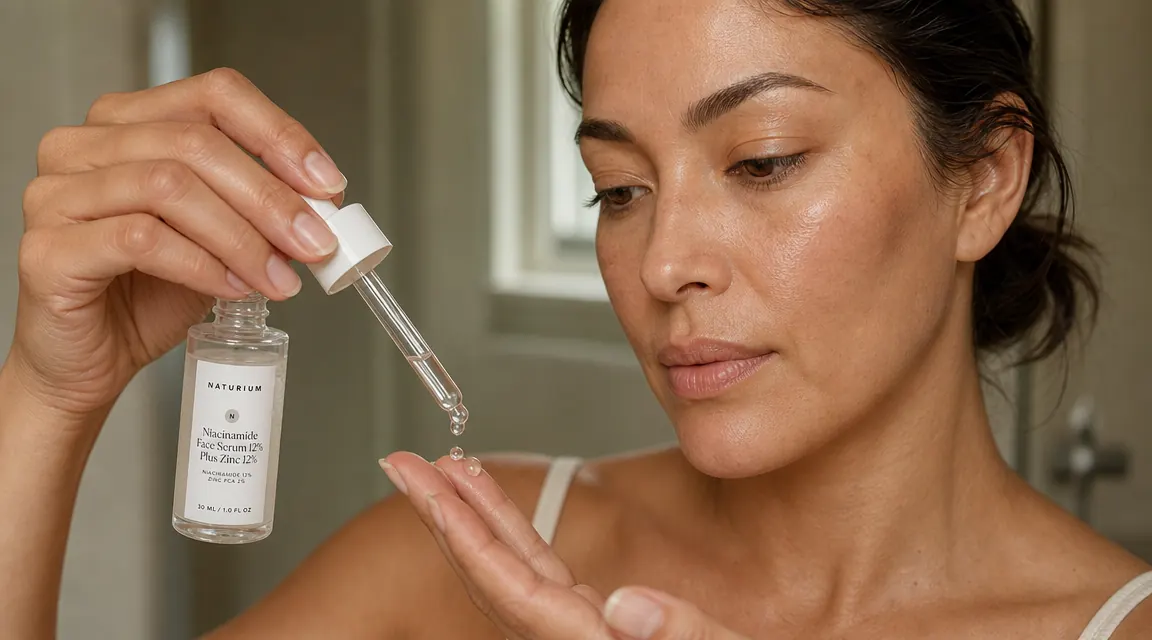
Here is where most people make a small but meaningful error. They towel off completely and then apply their serum to dry skin. Niacinamide absorbs well either way, but applying it to skin that is slightly damp from cleansing helps the formula spread more evenly without tugging, and it can support faster penetration.
Dispense two to three drops of the serum onto your fingertips. I use the Naturium Niacinamide 12% + Zinc 2% because it has one of the higher niacinamide concentrations available at this price point, and the texture is thin enough to layer easily. Press it gently into the skin rather than rubbing. Use a light pressing motion across the nose, cheeks, forehead, and chin. You do not need to massage it in aggressively.
Do not use too much. More product does not mean faster results with niacinamide. Two to three drops is genuinely enough to cover the full face. Using a larger amount just means the excess sits on the surface and gets wiped off when you apply your next step.
Step 3: Wait 30 to 60 Seconds Before Layering
Serums are thin and absorb relatively quickly, but rushing the layering process is one of the most common mistakes I see. If you apply moisturizer immediately after the serum, you can trap unabsorbed product on the surface and reduce how much actually reaches the skin.
Give the niacinamide 30 to 60 seconds to absorb before moving to the next step. You will know it is ready when the surface of your skin no longer feels wet or slippery. This does not need to be timed with a clock. It is usually the amount of time it takes to put the bottle cap back on, set it down, and take one slow breath.
Niacinamide is not a one-use fix. The results come from consistent daily use over four to eight weeks. Think of it as a long investment in how your skin behaves, not a treatment for this morning's oily T-zone.

Step 4: Seal with a Non-Comedogenic Moisturizer
Skipping moisturizer when your goal is oil control is a mistake I made early on and that I see a lot of people with oily skin still making. The logic seems sensible: if my skin already produces too much oil, why would I add more? But moisturizer and oil are not the same thing. A well-formulated moisturizer provides hydration, not grease, and it reinforces the skin barrier that niacinamide is already working to strengthen.
When skin is dehydrated, it often responds by producing more sebum to compensate. That is the cycle you are trying to break. A lightweight, gel-based, or water-based moisturizer labeled non-comedogenic (meaning it is formulated not to clog pores) gives your skin the hydration it needs without adding to the oiliness problem. Apply a pea-sized amount after the niacinamide has absorbed. In the morning, follow with sunscreen.
Step 5: Protect the Work with SPF Every Morning
This step is not optional. Sun exposure is one of the primary causes of enlarged pores over time. UV damage breaks down collagen and elastin, which are the structural proteins that hold pore walls in place. As that support structure weakens, pores look larger and more open. If you are using niacinamide to minimize pore appearance, skipping SPF is working against yourself.
Apply a broad-spectrum SPF 30 or higher as the final step of your morning routine, after moisturizer has absorbed. A mineral or hybrid mineral-chemical formula tends to sit better over serum and moisturizer without pilling. This step also protects the vitamin B3 in your serum from UV degradation, which helps the formula stay active longer on your skin.
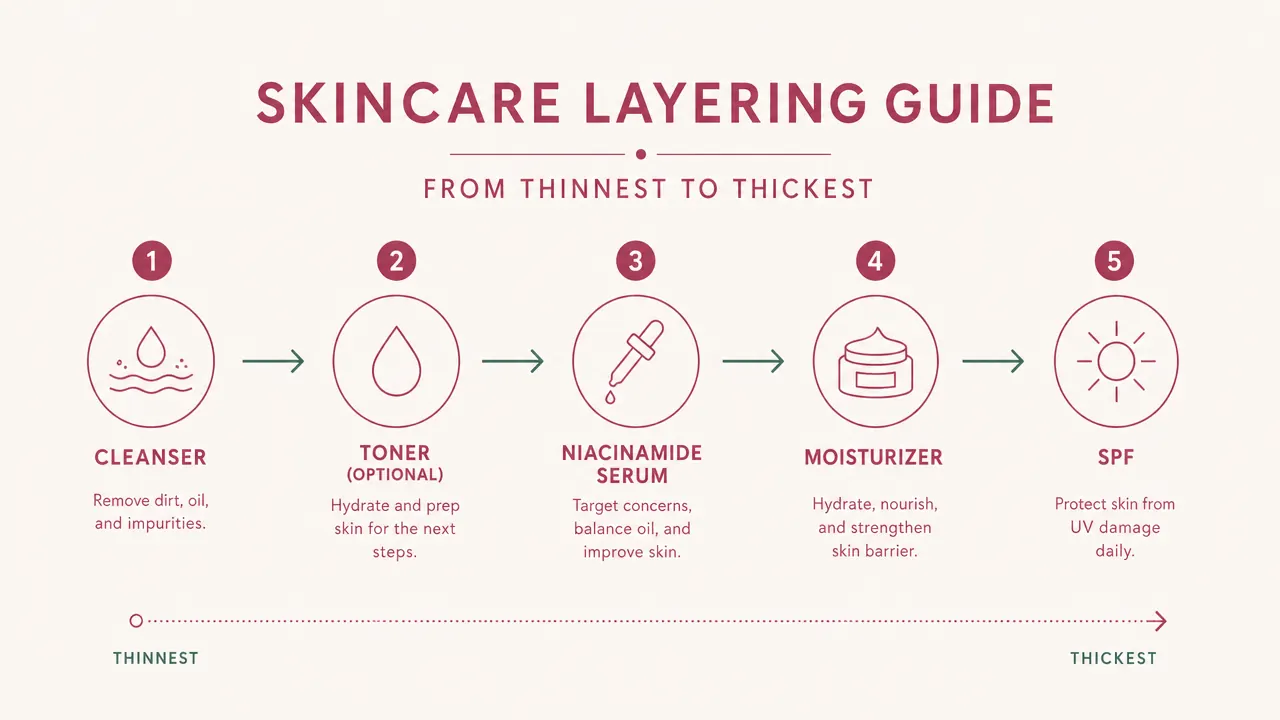
The full morning sequence is: cleanser, niacinamide serum, moisturizer, SPF. The evening sequence drops the SPF: cleanser (double if you wore makeup or sunscreen), niacinamide serum, moisturizer. That is it. You do not need a 10-step routine for this to work.
What Else Helps (and What to Avoid)
A few things make this routine more effective. Chemical exfoliation with a BHA like salicylic acid two to three times per week can help clear out the sebum and debris that stretch pores from the inside. Salicylic acid is oil-soluble, which means it can actually get into the pore lining in a way that water-soluble acids cannot. Use it in a separate step, either on the evenings you skip niacinamide or alternated with it. Do not layer a BHA directly on top of your niacinamide serum in the same step.
Clay masks used once or twice a week can pull excess sebum from pores and leave them looking temporarily tighter. They are not a long-term fix on their own, but as a complement to a consistent niacinamide routine they are useful. Avoid scrubs with physical beads or gritty particles. They can micro-tear skin, cause inflammation, and ultimately make pore issues worse over time.
One thing I would skip entirely: heavy, occlusive moisturizers like petroleum-based creams or rich shea butter formulas. For oily and pore-prone skin, these tend to sit on top rather than absorb, and they can contribute to the congestion that makes pores look larger. Stick to gel or lightweight lotion textures.
How Long Until You See a Difference
This is the most important expectation to set before you start: niacinamide is not a one-use fix. Most people notice a meaningful change in oil control within two to three weeks. Visible improvement in pore appearance typically shows at four to six weeks, with the most noticeable change around the eight-week mark for people with significantly enlarged pores.
If you stop using it, the benefits gradually reverse. Your skin is not permanently altered. This is a maintenance ingredient, not a one-and-done treatment. That said, the Naturium formula is priced low enough that keeping it in rotation long-term is reasonable. I have been using it consistently for over four months, and the difference in midday oiliness and the appearance of my nose and chin pores is noticeable to me in a way that earlier, cheaper serums with lower concentrations never produced.
If you want a deeper look at how the Naturium formula performs over a full eight weeks with before-and-after notes on pore appearance, texture, and breakouts, my full review covers all of that. And if you are curious whether niacinamide is the right active for your skin concerns generally, the breakdown of what it does for skin clarity is worth reading before you commit.
Ready to start the routine? Here is the serum that makes it straightforward.
Naturium Niacinamide 12% + Zinc 2% is the formula I use daily for pore minimization and oil control. At this price, it is easy to stay consistent for the full eight weeks this routine requires.
Amazon Check Today's Price on Amazon →