
My previous retinol attempts always followed the same pattern. I'd buy something, use it three or four nights in a row, wake up to dry, slightly raw-feeling skin, and quietly put the tube in the back of the cabinet. I told myself it wasn't the right formulation, or maybe my skin was just too sensitive. What I was actually doing was going too fast and then quitting before my skin had a chance to adapt. I started RoC Retinol Correxion Night Cream for Deep Wrinkles in early January with one rule: slow is the whole point. I used it two nights a week for the first month. What followed over the next three months surprised me in some ways and confirmed what I already suspected in others.
RoC is the product I reach for when someone asks me to name a retinol night cream that a first-timer can realistically stick with. It has a 4.4-star average across nearly 24,000 Amazon reviews, and it's priced affordably at most retailers. But the review count and price aren't why I recommend it. I recommend it because the cream formulation buffers the retinol delivery in a way that makes the initial adaptation phase genuinely manageable, and because three months of nightly use produced measurable changes in the areas I actually cared about.
The Quick Verdict
A well-buffered retinol night cream that's genuinely tolerable for sensitive beginners, with real results on fine lines and texture by week eight. Not the fastest-acting formula, but the consistency payoff is real.
Amazon Check Today's Price →If your fine lines have been sitting on a shelf in a tube you gave up on, this is the retinol to restart with.
RoC Retinol Correxion Night Cream is consistently available on Amazon, and the current price sits well below what most dermatologist-brand retinols charge for the same active ingredient.
Amazon Check Today's Price on Amazon →How I've Used It
My skin is combination, normal to oily through the T-zone, drier on my cheeks, with some sensitivity around the nose. I'm in my early forties. The crow's feet I mentioned have been the persistent concern, along with some forehead lines that have become more defined over the past two years. I have not had any professional retinol or resurfacing treatments. This is over-the-counter territory.
Week one and two: I applied a pea-sized amount to clean, dry skin two nights per week, Monday and Thursday. I waited twenty minutes after washing my face before applying, which reduces irritation without the need to literally sandwich it between moisturizer layers. I followed with a simple fragrance-free moisturizer on top. No peeling, no redness. Some mild tightness the morning after during week two, which resolved by midday.
Weeks three and four: I moved to three nights per week. There was one morning near the end of week three where I had noticeable dryness on my left cheek, which I now think was from the combination of RoC and a slightly harsh cleanser I was using. I switched to a gentler wash and the dryness didn't return. No peeling. Week five onward I went to nightly use, which is where I stayed through the end of the three months.
What the Formula Actually Contains
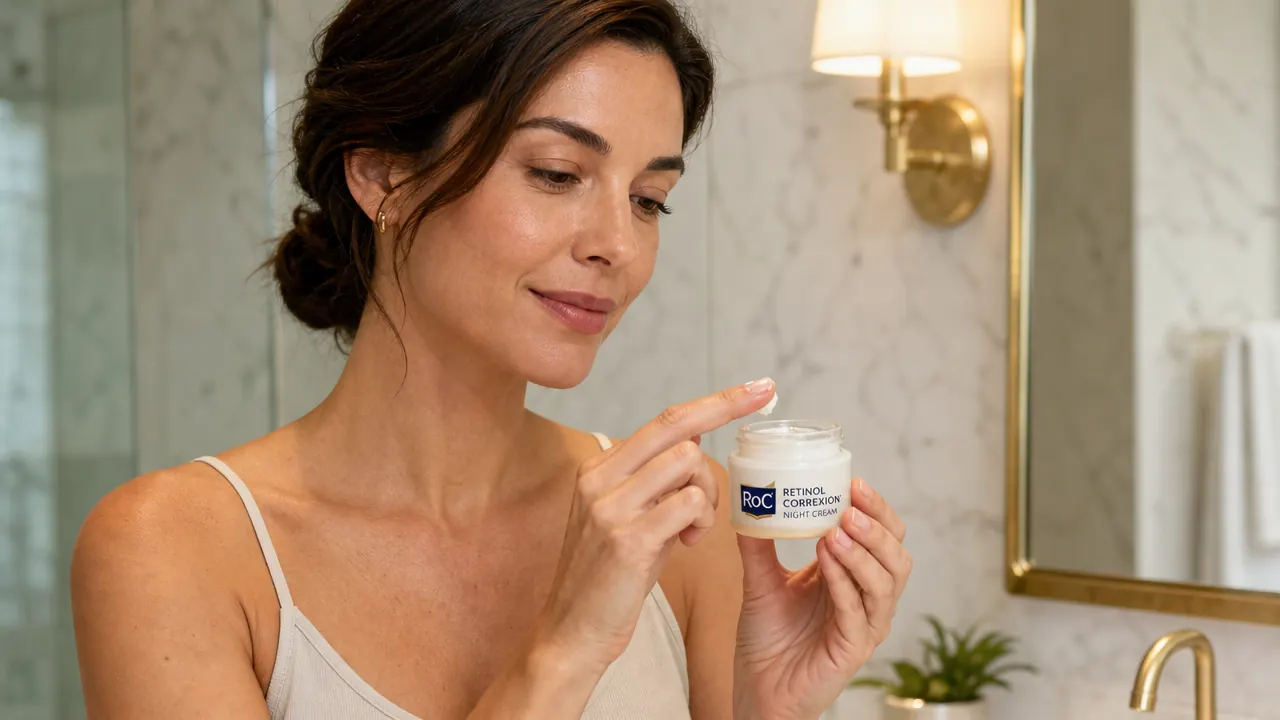
RoC Retinol Correxion Night Cream uses pure retinol, not a retinol ester like retinyl palmitate or retinyl acetate. That distinction matters. Retinyl esters are weaker and require more conversion steps in the skin to become active retinoic acid. Pure retinol needs fewer steps, which means it delivers more visible results at a lower stated concentration. RoC doesn't publish the exact percentage on the label, but the formulation has been in use since the 1990s with a long track record of clinical testing.
The cream base includes mineral oil, glycerin, and petrolatum alongside the retinol. That combination acts as a buffer, slowing down how aggressively the retinol penetrates. For people with skin that tends to react to actives, that's genuinely useful. It also means the jar can function as a moisturizing step, not just a treatment, which simplifies the nighttime routine. The texture is a medium-weight cream, not a gel or serum, and it has a faint clinical scent that dissipates quickly.
One formulation note worth flagging: this cream contains fragrance. If your skin reacts to fragrance, that's a real consideration. The concentration appears low, since I've seen no reaction to it personally, but if you have a diagnosed fragrance sensitivity, check the full ingredient list before committing.
Results at Six Weeks and at Three Months
At six weeks of regular use, my forehead texture was noticeably smoother under raking light. The fine horizontal lines near my brow looked softer, not gone, but less like creases and more like surface-level texture. I took reference photos at the start and compared them at week six. The difference was subtle but real: less surface roughness, an overall more even quality to the skin in that area.
By week ten, the crow's feet had visibly softened. These are lines that form from muscle movement, not just surface texture, so retinol can only do so much, but the depth of the static lines (the ones visible even without squinting) had reduced in a way I could see in both photos and in natural lighting. My skin tone also evened out slightly through the cheek area, which I wasn't specifically targeting but was a welcome side effect.
At the twelve-week mark, the improvements were consistent with what you see reported across multiple RoC clinical studies: reduced appearance of fine lines, improved skin smoothness, some improvement in overall tone. None of this is instant, and none of it is dramatic in the way a procedure would be. What it is, is real and cumulative. The skin at month three looks genuinely different from the skin at week zero, in a way that photographs confirm and that people who see me regularly have noticed without being prompted.
By week ten, the depth of the static crow's feet lines had visibly reduced. Not erased. Reduced. That's the honest version of what consistent retinol use looks like.
Tolerability Compared to Other Retinols I've Tried
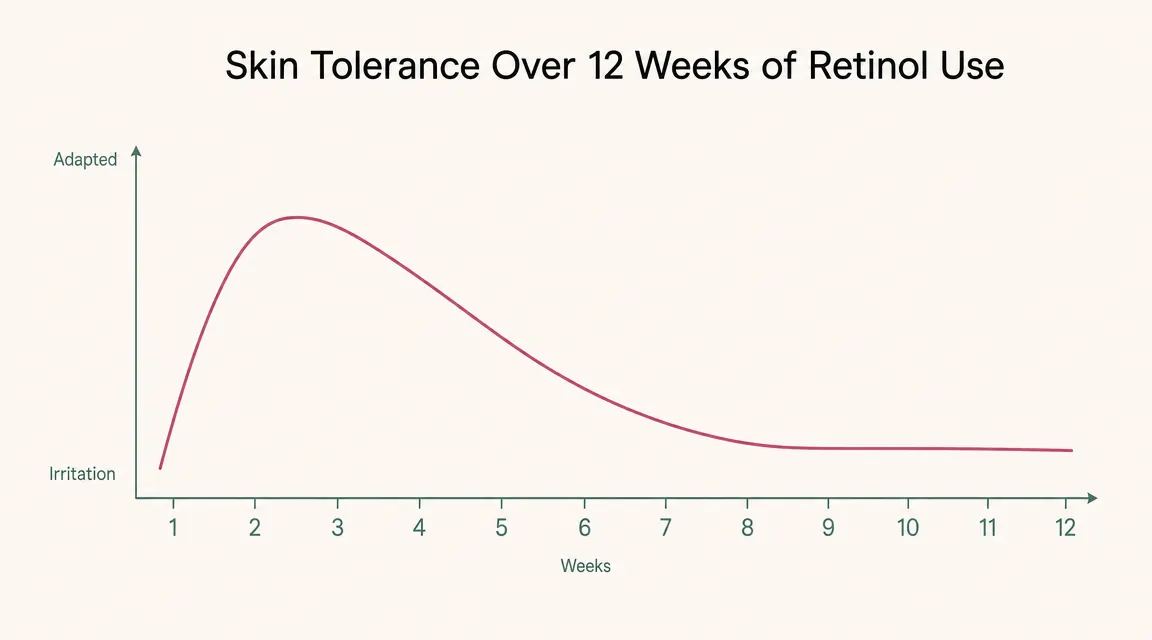
Before this run, I had abandoned two other retinol products. One was a prescription-strength tretinoin at a low percentage, which my dermatologist recommended a few years ago. I lasted about a month before the peeling became too disruptive. The other was a higher-concentration retinol serum from a skincare brand that markets to the same demographic as RoC. That one caused consistent morning redness at the outer cheeks that didn't resolve after four weeks, which I eventually decided wasn't worth continuing.
RoC Retinol Correxion is measurably more forgiving than either. The cream base is a meaningful part of that. The slow-ramp approach helped too, but I think I could have even started at three nights per week without significant issue given how mild this formula runs. It is not zero-irritation for everyone. If you have rosacea or a consistently reactive barrier, I'd still recommend starting slowly. But for combination, normal, or mildly sensitive skin? The tolerability here is genuinely good.
Where It Falls Short
The pace of results is slow. That's not a criticism, it's the nature of any over-the-counter retinol, but it's worth naming because some of the language on the RoC packaging implies faster outcomes than most people will actually see. The "12 weeks" timeline on the box is realistic, but month one and month two can feel like you're doing a lot of work for modest visible return. You have to trust the process through that window.
The jar packaging is also worth noting. Retinol degrades when exposed to light and air, and a jar requires you to dip your fingers in regularly, which exposes the product to both. Some dermatologists specifically recommend avoiding jar packaging for retinol products for this reason. RoC does use an opaque jar, which helps with light exposure, but the repeated air exposure over the course of finishing a jar is a real consideration. If you want maximum potency stability, a pump or tube formulation would be preferable. That said, I've used my current jar over twelve weeks and it shows no signs of formulation breakdown.
Finally, the retinol concentration is not disclosed on the label. For people who want to know exactly what percentage they're applying, or who want to track and increase dosage over time with full transparency, that lack of information is frustrating. Products like The Ordinary Retinol 0.5% in Squalane publish their concentration. RoC does not. The company's rationale has historically been that their patented stabilization process makes percentage comparisons to other brands unreliable, but it still leaves users without a baseline number.
What I Liked
- Pure retinol (not a weaker retinol ester), so results are more reliable at the same dose
- Cream base buffers the retinol delivery, making the adaptation period genuinely manageable
- Visible results on fine lines and texture by week six to eight with consistent nightly use
- Available widely at drugstores and on Amazon, priced accessibly for a real retinol product
- Nearly 24,000 reviews with a 4.4-star average, one of the most-validated retinols at this price point
- Functions as both treatment and moisturizer, simplifying the nighttime routine
Where It Falls Short
- Contains fragrance, which may be a concern for reactive or fragrance-sensitive skin
- Jar packaging exposes product to air each use, which can accelerate retinol degradation over time
- Retinol concentration is not disclosed on the label
- Results timeline is slow, month one and two feel like a holding pattern before visible change starts
- The clinical scent isn't unpleasant but is noticeable, not a luxurious fragrance experience
Who This Is For
RoC Retinol Correxion Night Cream is the right starting point for anyone who wants to use a real retinol product but hasn't been able to get past the initial irritation that kills most retinol routines. If you have combination, normal, or mildly sensitive skin, you're between 30 and 60, and you want to address fine lines and texture without spending in the higher range, this is a well-supported choice. It's also a good option if you've tried harsher retinol serums and found them too aggressive. The cream base and the pacing it allows make the long-term commitment much easier to maintain.
Who Should Skip It
If you have a confirmed fragrance sensitivity or rosacea, the fragrance in this formula is a real risk and there are fragrance-free retinol alternatives worth exploring first. If you want a retinol with a published concentration so you can track and escalate your dosage deliberately, this formula won't give you that transparency. And if you want faster visible results and are willing to accept more initial dryness and peeling to get them, a slightly higher-strength product or a serum format would serve you better. RoC is a slow-and-steady formulation. Some people want faster.
For a deeper comparison between this cream and a competing retinol serum option, see my breakdown at RoC Retinol Night Cream vs CeraVe Retinol Serum. And if you're completely new to retinol and want a step-by-step protocol before you start, I cover the full low-and-slow introduction method at How to Start Using Retinol Without Irritation.
Three months is what it takes to see real retinol results. RoC makes those three months bearable.
If you've been on the fence about adding retinol to your routine, the combination of a manageable formula, a strong track record, and an accessible price point makes this a low-risk place to start. Check the current price on Amazon before you buy anywhere else.
Amazon Check Today's Price on Amazon →